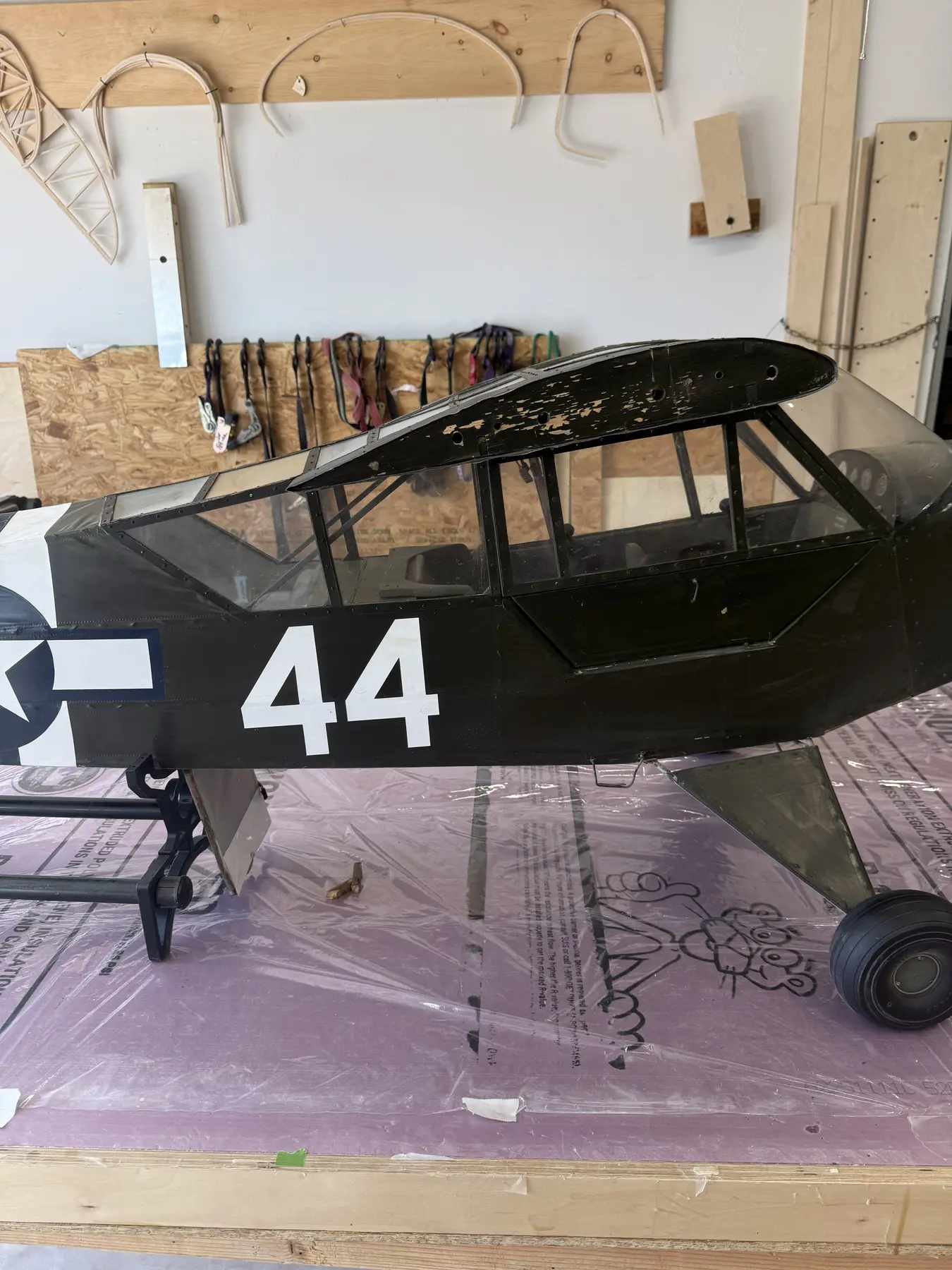
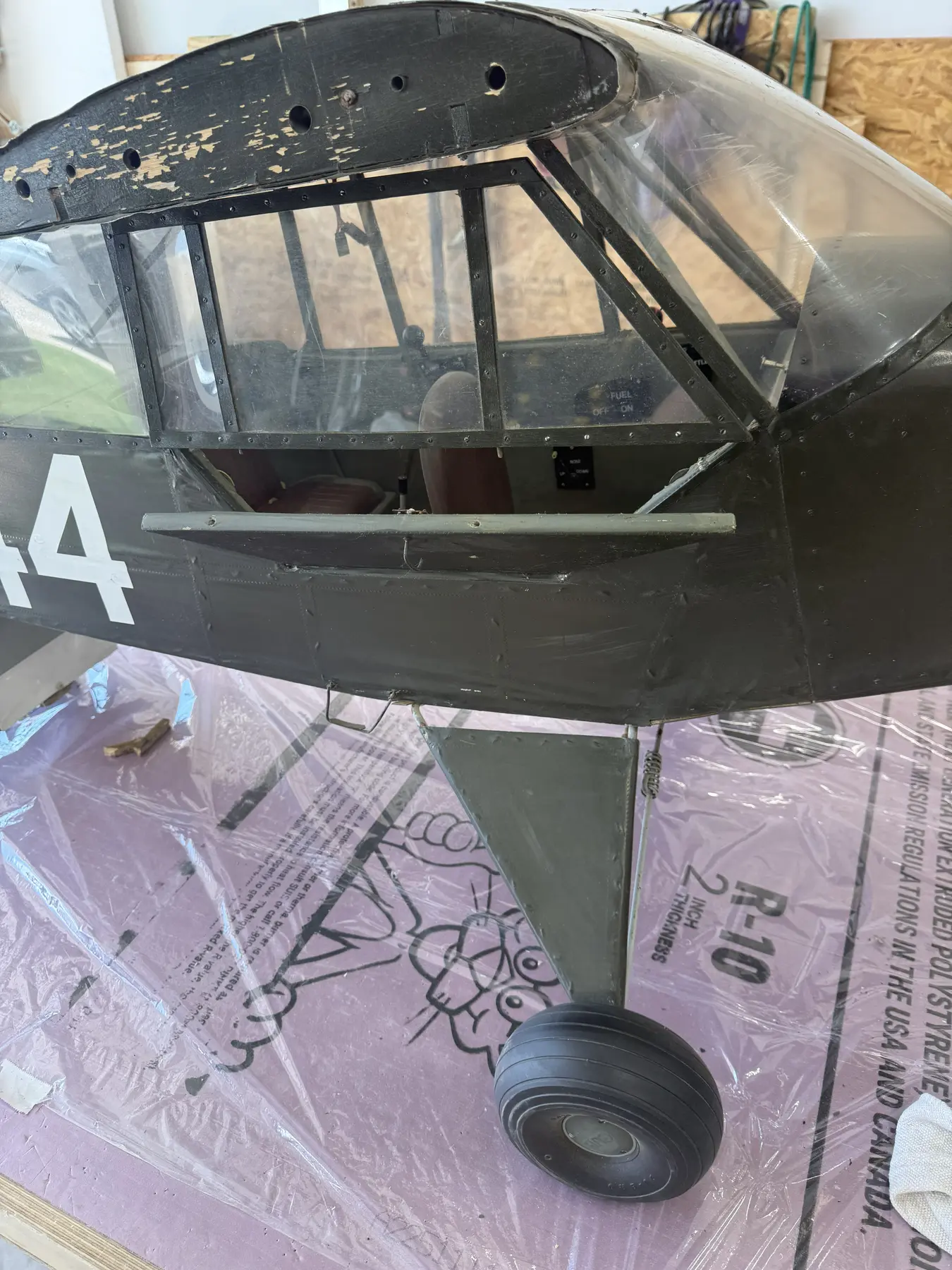
A developed 1/3-scale Balsa USA Cub airframe arrived with good wings, a valuable greenhouse and cockpit record, and major reconstruction needs in the empennage, rear fuselage, and belly-access system.
This chapter preserves the aircraft exactly as it was found before restoration decisions changed its structure, appearance, or story.
These views preserve the received finish, greenhouse, markings and overall configuration before teardown altered what could be seen.
As-received left sideExisting finish and markings documented before teardown.Greenhouse and forward fuselageOriginal glazing, framing and cockpit relationships.
The Starting Point
A large airframe worth restoring
The aircraft was acquired as a used 1/3-scale Balsa USA J-3/L-4 airframe. It was not a bare kit and it was not a simple repair project. A previous builder had already created a complete aircraft with a developed greenhouse, doors, cockpit interior, landing gear, wing structure, fittings, and scale character.
The restoration therefore begins with respect for the work already present. The goal is not to erase the original builder's choices. It is to understand them, preserve the sound work, and rebuild only where safety, geometry, durability, serviceability, or historical presentation requires it.
Overall Condition
What the aircraft brought into the hangar
Wings
Generally good
The wings appeared to be the strongest major assemblies. They still require separate structural surveys, local repairs, renewed aileron hinges and controls, rebuilt servo access, strut-hardpoint verification, pitot installation, and concealed future wiring.
Fuselage
Sound areas mixed with major work
The central fuselage and cabin contained valuable original construction, while the lower fuselage, belly hatches, landing-gear load paths, rear framework, and tail mounting area required substantial reconstruction and careful alignment.
Empennage
Complete replacement required
The horizontal stabilizer, elevators, fin, and rudder were not suitable as flight structures. They remain useful as photographed and measured reference pieces, but all four surfaces will be rebuilt from the Balsa USA plans.
The greenhouse was not treated as a blank slate. Its windshield, roof panels, side windows, rear glazing, door arrangement, framing, retaining strips, hinge positions, latch locations, and mounting holes document a developed model installation.
The clear material was cloudy, scratched, aged, and poorly fitted in places, but the underlying configuration remained the restoration baseline. New 0.040-inch clear PETG will replace the glazing while the major geometry, original aluminum strips, and photographed operating relationships are preserved or faithfully reproduced.
Functional miniature latches and improved hardpoints will enhance safety and durability without converting the greenhouse into a different design.
Cockpit Interior
Reusable pieces, not disposable decoration
The photographed preformed floor, seats, instrument panel, side panels, and related cockpit pieces are part of the aircraft's restoration record. Their positions, orientation, colors, and attachment relationships are documented before removal or alteration.
Usable pieces will be cleaned, repaired, reinforced, refinished, and returned to the aircraft. Only badly damaged or unfit components will be replaced. Modern receivers, batteries, telemetry, wiring, and equipment trays will be concealed beneath or behind removable interior sections.
Firewall, Cowl, and Nose
Preserve geometry; rebuild the working module
The firewall location and thrust-line relationship are retained as the geometric starting point. The existing two-piece plastic cowl is replaced by the approved one-piece fiberglass Balsa USA-style J-3/L-4 cowl.
The final electric motor, ESC, propeller, batteries, cooling, wiring, and 3D-printed Continental engine detail remain dependent on the completed airframe's weight, balance, clearance, and performance needs. Components from the separate 1/4-scale Cub are not assigned to this aircraft.
Landing Gear and Lower Fuselage
Existing geometry with a rebuilt load path
The landing gear and its relationship to the fuselage are documented before rebuilding begins. Mounting blocks, plates, cross-members, lower longerons, fasteners, and prior repairs are inspected for crushing, looseness, cracking, distortion, and hard-landing evidence.
The major belly-hatch rebuild must restore continuous structure around the gear while still providing practical access to future batteries, receivers, wiring, and service connections.
Left and Right Wings
Preserve the good work and correct the service systems
Each wing is reviewed independently against the plans and teardown photographs. Sound spars, ribs, cap strips, leading edges, trailing edges, roots, and tips remain. Local damage is repaired rather than prompting broad replacement.
The restoration also renews aileron hinges and controls, rebuilds servo trays and hatches, verifies strut hardpoints, protects wiring passages, and integrates the FrSky PAS70 ADV pitot system with accessible tubing and sensor installation.
Rear Fuselage and Empennage
The major reconstruction zone
The tail area requires more than patching. The fuselage must be jigged straight, a centerline and datum established, and the tailpost, stabilizer platform, fin support, lower rear structure, and adjoining framework reconstructed to the Balsa USA geometry.
The horizontal stabilizer, elevators, fin, and rudder will be completely new. The received tailwheel hardware, new rudder pull-pull system, new elevator control system, hinges, joiners, hardpoints, and mounting geometry will be integrated and tested before covering.
Preserve and Reuse
Components that remain part of the flying aircraft
Structure
Sound wing and fuselage members, major greenhouse framework, and reliable original metal fittings.
Interior
Usable preformed cockpit pieces restored and returned to their documented locations.
Hardware
Original aluminum glazing strips and other fittings that remain straight, sound, serviceable, and historically useful.
Reference Material
Parts that may not fly again but still matter
Original glazing, damaged empennage components, retired hardware, old control pieces, templates, and other removed items can preserve dimensions, drilling patterns, surface relationships, fabrication clues, and the history of the aircraft's earlier construction.
Important removed components are photographed, labeled, measured, and retained as restoration-reference artifacts rather than being discarded without a record.
No original glazing, component, fitting, marking, hardware item, or structural detail is discarded, trimmed, drilled, or altered before it has been photographed, measured, labeled, and entered into the project record.
This rule protects more than parts. It preserves evidence. A damaged item may contain the only surviving hole pattern, bracket location, panel shape, latch geometry, color layer, or clue to how the aircraft was previously assembled.
Continue the Story
From the baseline to teardown
The as-received record establishes what the aircraft was. The next chapter uses the exposed structure and matched before-and-after photographs to identify the repairs, reconstruction, and preservation work ahead.