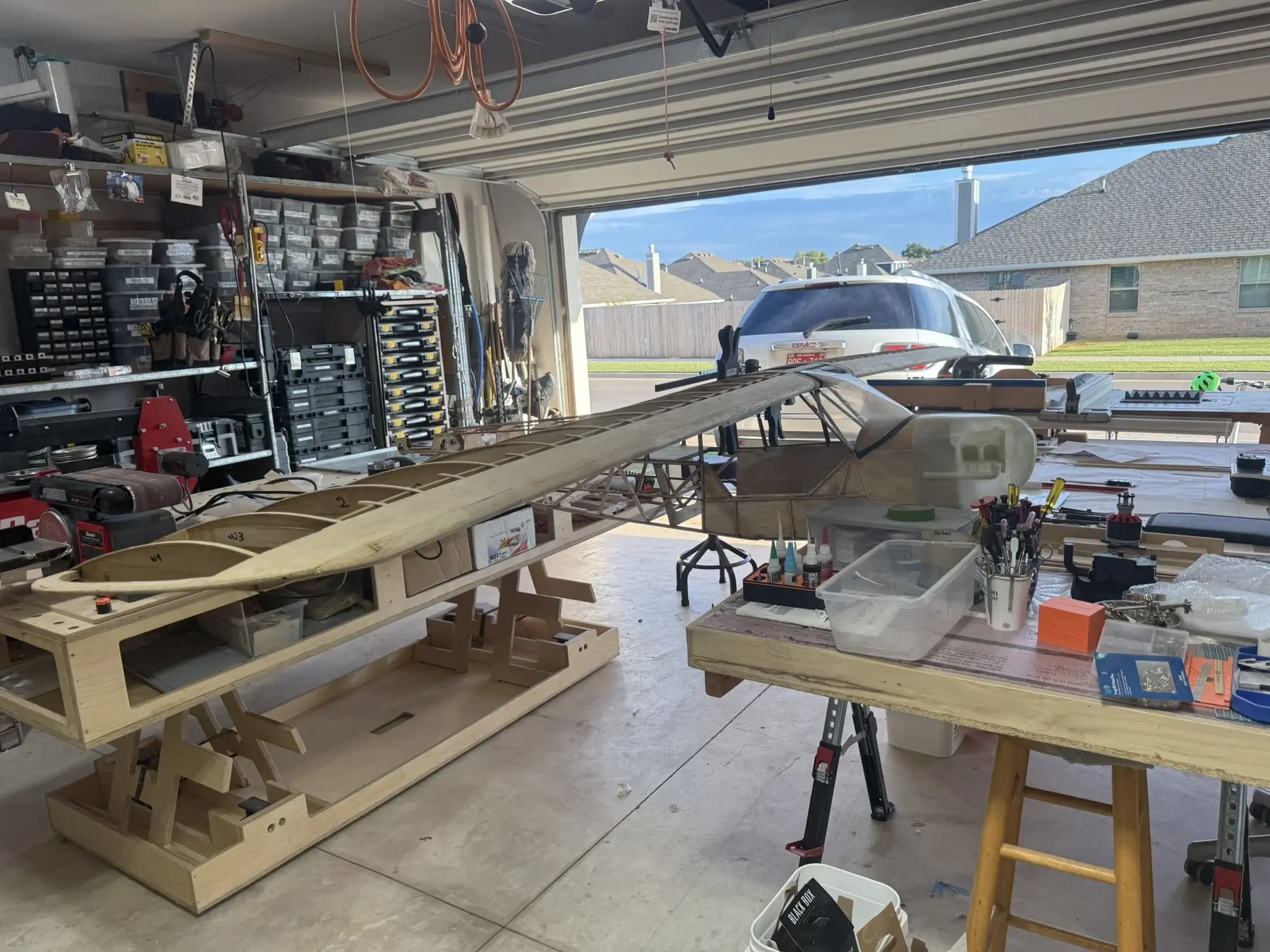

L-4 Engineering Rabbit Hole
Motor, ESC &
Propeller Sizing
Starting With the Airframe, Not the Motor Catalog
Selecting an electric power system for the Balsa USA 1/3-scale L-4 Grasshopper is more than finding a motor capable of producing enough watts. The motor, ESC, battery voltage, propeller diameter and pitch all have to work together — and they have to fit the airplane.
The governing sequence
Start with the airplane.
For this restoration, that meant answering a basic question before choosing the motor:
How large a propeller can the L-4 actually use?
The working flying-weight estimate for the airplane is 35 pounds. At that size, a larger, slower-turning propeller is attractive. It can provide the strong low-speed thrust appropriate for a Cub while keeping the power system closer to the character of the full-scale airplane.
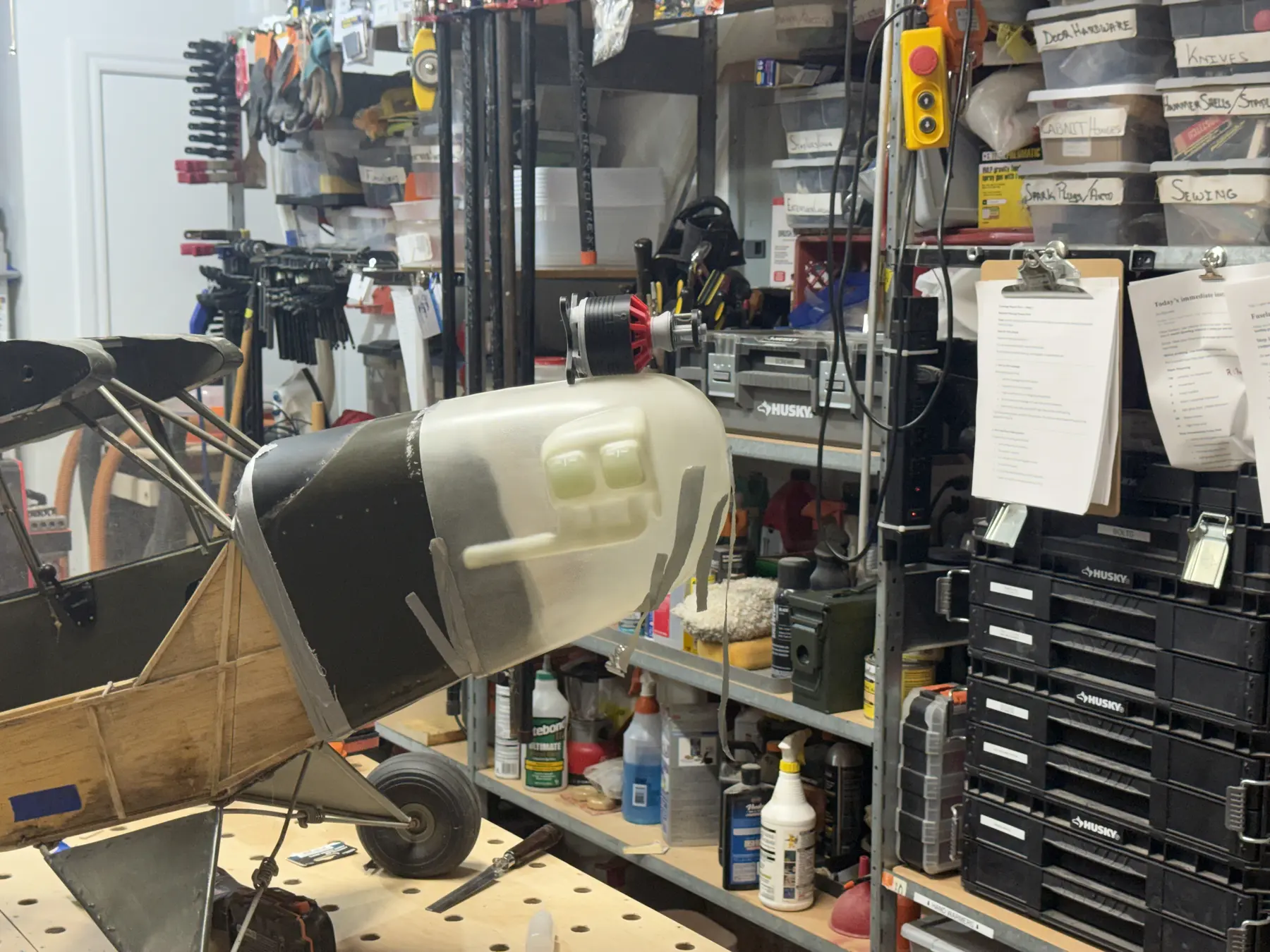
A 24-inch propeller emerged as the initial design target. But before allowing that number to drive motor selection, we needed to establish whether it had adequate ground clearance.
Plan-derived geometry
Establishing the 24-Inch Propeller Envelope
Rather than estimate clearance from photographs or simply assume that a 24-inch prop would fit a 1/3-scale Cub, we went back to the original Balsa USA drawings.
The key source was the Balsa USA S02 Various Details plan, supported by the fuselage side-view drawing.
Using the established 5.58-inch main-wheel diameter as an internal scale reference, the drawing geometry placed the propeller-shaft center approximately 13.95 inches above the main-wheel axle center.
The 5.58-inch wheel has a radius of:
5.58 ÷ 2 = 2.79 inches
That produces an estimated propeller-shaft height of:
13.95 + 2.79 = 16.74 inches
A 24-inch propeller has a 12-inch radius, leaving:
16.74 − 12.00 = 4.74 inches
Calculation basis: the high-resolution S02 rendering measured approximately 524 pixels across the 5.58-inch main wheel, or about 93.9 pixels per inch. The approximately 1,309-pixel axle-to-thrust-line separation converts to about 13.95 inches. This is a plan-derived geometric estimate, not a photographic estimate.
Nominal geometric ground clearance with a 24-inch propeller: approximately 4¾ inches.
That was enough to keep 24 inches as the working propeller diameter for the power-system study.
Now the motor can be sized around the airplane instead of the airplane being adapted to a motor.
Power requirement
How Much Power Does a 35-Pound L-4 Need?
The next question is not simply, “How many watts can we put into it?”
The better question is:
How much power does this airplane need to fly the way an L-4 should?
This is a large, relatively slow Cub-type airplane. It is not being designed for unlimited vertical aerobatics. What matters is dependable takeoff performance, strong acceleration, comfortable climb authority, realistic cruise and adequate reserve for wind or a go-around.
For preliminary sizing, three power levels are useful:
| Power loading | 35-lb airplane | Interpretation |
|---|---|---|
| 100 W/lb | 3,500 W | Lower end of the useful range |
| 125 W/lb | 4,375 W | Strong scale-performance target |
| 150 W/lb | 5,250 W | Substantial reserve |
For this airplane, approximately 4.0–4.5 kW of usable maximum power is a sensible design center, with equipment capable of tolerating something closer to 5 kW without being operated continuously at its limits.
That distinction is important.
We don’t necessarily want to use 5 kW.
We want enough system capacity that normal L-4 flying isn’t continually pushing the motor and ESC to their maximum ratings.
Electrical direction
Voltage Changes Everything
Once power rises into the 4–5 kW range, battery voltage becomes a major design decision because:
Watts = Volts × Amps
Suppose the airplane needs approximately 4,500 watts.
At roughly 22.2 volts nominal on 6S, the theoretical current would be:
4,500 ÷ 22.2 ≈ 203 amps
That is an enormous current for a large scale airplane.
It means heavier wiring, larger connectors, greater resistive losses, greater battery stress and a much more demanding ESC installation.
This is why the original idea of using 6S deserves reconsideration for the 1/3-scale L-4.
Increasing voltage dramatically reduces current for the same power.
Approximate theoretical current for 4,500 watts becomes:
| Battery | Nominal voltage | Approx. current at 4.5 kW |
|---|---|---|
| 6S | 22.2 V | 203 A |
| 8S | 29.6 V | 152 A |
| 10S | 37.0 V | 122 A |
| 12S | 44.4 V | 101 A |
Actual flight measurements will differ because battery voltage changes under load and motor/ESC/propeller behavior is more complicated than simple division. But the comparison shows why higher voltage becomes attractive.
For a 35-pound airplane operating around this power level, 10S–12S deserves serious consideration, with 12S providing a particularly attractive current range.
Motor direction
What That Means for Motor Kv
Voltage cannot be selected independently of motor Kv and propeller load.
With our working 24-inch propeller, we do not want an extremely high-RPM power system. A Cub benefits from turning a relatively large propeller at sensible speed and producing strong static and low-speed thrust.
That pushes the motor search toward a large, relatively low-Kv outrunner.
The exact Kv cannot responsibly be locked until candidate motors and specific 24-inch propeller pitches are modeled or tested. But the design direction is now clear:
Large-diameter, low-Kv motor + higher battery voltage + 24-inch propeller.
That combination is preferable to trying to obtain several kilowatts from a high-Kv motor on 6S at extremely high current.
Propeller Pitch Becomes the Tuning Tool
Establishing a 24-inch diameter does not mean we have selected the final propeller.
Diameter is only half of the specification.
A 24×10, 24×12 and 24×14, for example, can impose substantially different loads on the same motor.
That gives us an important tuning mechanism.
Once the motor and voltage are narrowed down, pitch can be used to balance:
For the L-4, the goal is not maximum pitch speed. The priority is strong low-speed thrust and efficient scale flight.
That argues against automatically selecting the most aggressive pitch the motor can survive.
Operating margin
ESC Sizing
The ESC should not be selected simply because its advertised maximum amperage happens to equal the predicted full-throttle current.
A giant-scale airplane deserves operating margin.
If the final 12S combination, for example, produces approximately 100–120 amps at full throttle, a 120-amp ESC would technically appear close to the requirement.
That does not automatically make it the ESC we should choose.
Temperature, cooling, propeller variation, battery voltage, timing and manufacturing tolerances can all alter actual current.
For this project, the ESC should have meaningful headroom.
Preliminary ESC Envelope
If testing ultimately shows approximately:
| Measured maximum | Preliminary ESC class |
|---|---|
| 80–100 A maximum | consider roughly a 120–130 A HV ESC |
| 100–120 A maximum | move toward approximately 150–160 A HV |
| 120–140 A maximum | approximately 160 A HV or greater, subject to the manufacturer’s continuous-current and cooling requirements |
For the power level currently being considered, the 150–160 A HV class is a particularly comfortable design region.
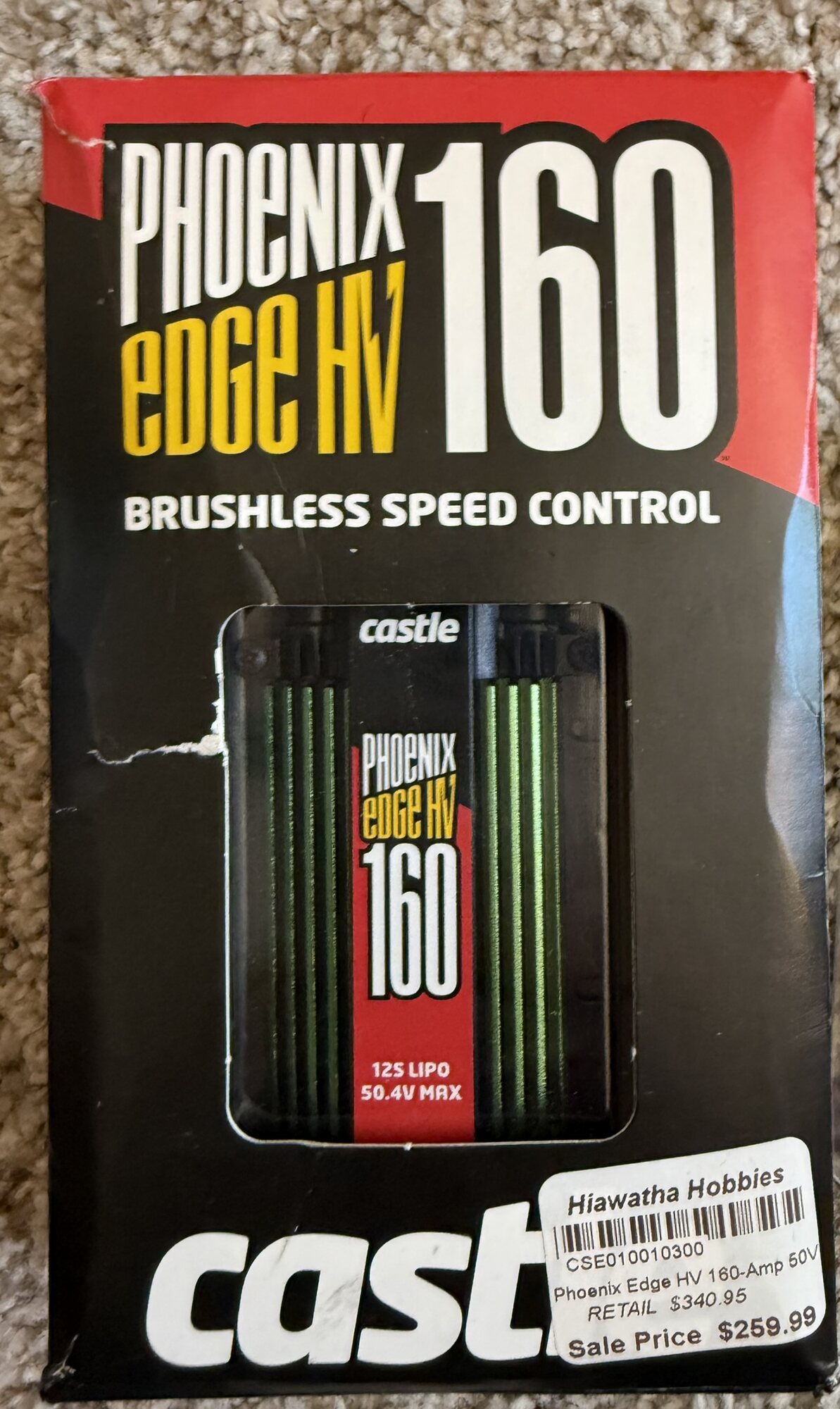
This is also where equipment already associated with the project becomes interesting.
The Castle Phoenix Edge HV 160 is a 12S-capable, high-voltage 160-amp-class ESC and therefore sits directly inside the type of electrical envelope emerging from this analysis.
That does not mean the motor must be selected merely because we already have that ESC.
The sequence remains:
If the final motor/propeller combination fits comfortably inside the Castle’s operating envelope, then using it becomes a logical result of the engineering rather than a predetermined requirement.
Receiver Power Remains Separate
There is another reliability consideration with a giant-scale airplane.
The propulsion ESC does not need to become the single point of failure for the radio system.
The L-4’s receiver/servo architecture is already being developed around the FrSky RB25S and two independent 2S LiFe receiver batteries.
That means propulsion power and flight-control power can remain deliberately separated.
For a large restoration such as this, that is exactly the kind of redundancy worth preserving.
Where the numbers now point
The Design Envelope Emerging
We have not yet selected the winning motor, and that is intentional.
But the airplane itself has now established a surprisingly narrow set of requirements:
- Aircraft
- Balsa USA 1/3-scale L-4 Grasshopper
- Design flying weight
- Approximately 35 lb
- Propeller diameter
- 24 inches
- Nominal prop clearance
- Approximately 4.74 inches
- Performance objective
- Strong, reliable scale performance
- Preliminary power target
- Approximately 4.0–4.5 kW, with additional system reserve
- Preferred electrical direction
- Higher voltage rather than extreme current
- Battery range for detailed evaluation
- 10S–12S
- Leading voltage candidate
- 12S
- Motor type
- Large low-Kv outrunner suitable for a 24-inch propeller
- Likely full-power current region on 12S
- Roughly 90–120 A, depending heavily on motor and prop pitch
- ESC class
- HV, with approximately 150–160 A providing desirable reserve if testing confirms this current range
- Existing ESC candidate
- Castle Phoenix Edge HV 160
Now we can finally open the motor catalogs.
But instead of asking:
“Which motor do we like?”
we can ask:
“Which motors actually satisfy this specification?”
That distinction is important.
BadAss, Scorpion and other serious candidates can now be compared against the same 35-pound aircraft, the same 24-inch propeller envelope, the same desired flight characteristics and the same reliability requirements.
From here, motors can be eliminated one by one — not because of brand preference, but because the numbers tell us which ones belong in the airplane.