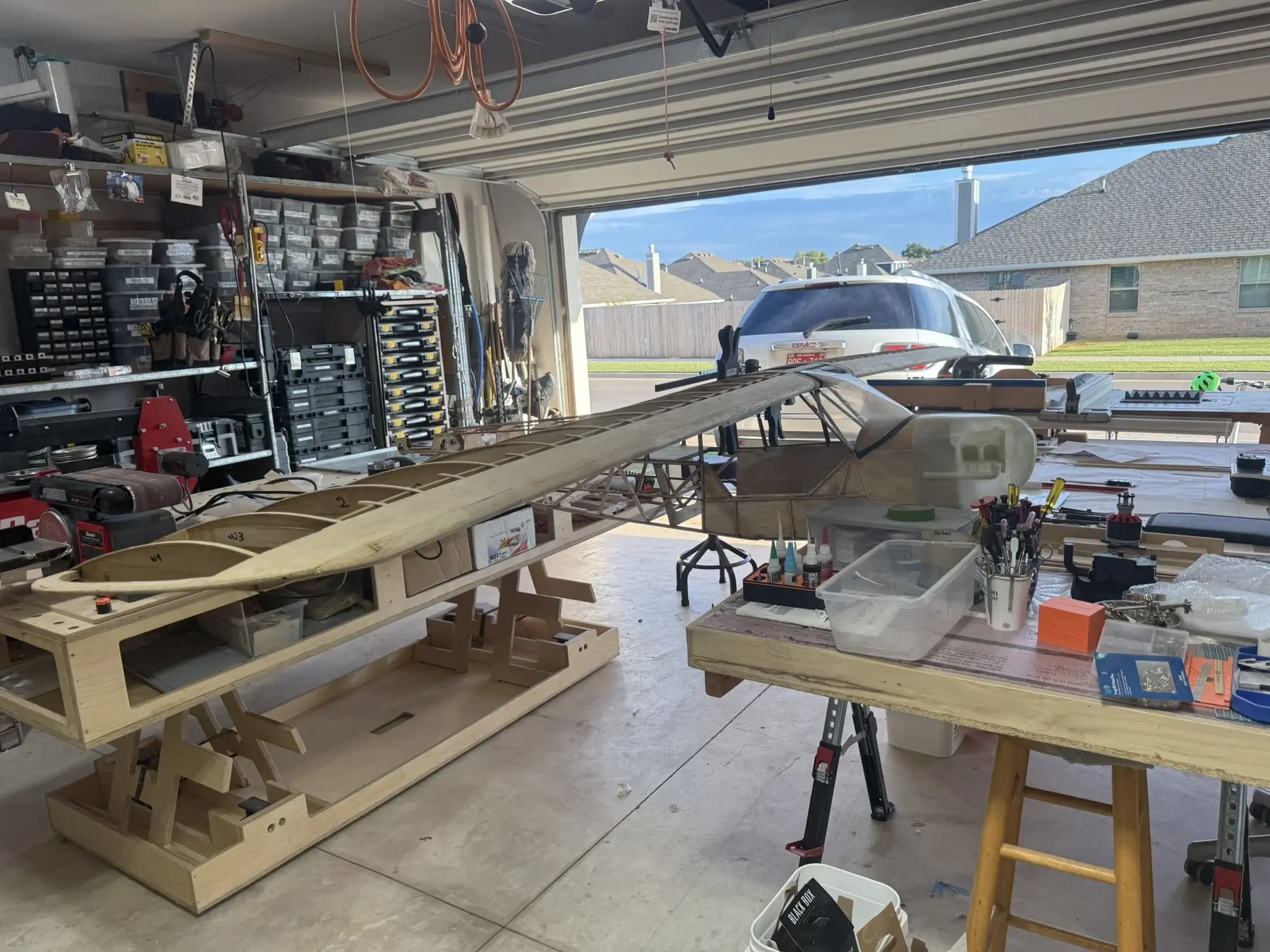
Jon's one-third-scale L-4 airframe assembled in the workshop

L-4 Engineering · Rabbit Hole

The Motor Was the Last Thing We Chose

The search started with the airplane and a propeller that had to clear the ground. It ended at a restored plywood firewall, where the favored motor still needs a trustworthy home.

Follow the story ↓

Start with the airplane

A 35-pound planning target is not a motor specification.

The L-4 is a large, slow Cub under restoration. Its estimated 35-pound flying weight is a design target, not a finished-aircraft measurement. Useful grass-field acceleration, climb, go-around authority and comfortable partial-throttle flight matter more here than a dramatic peak-power number.

That changed the order of the questions. First came the airframe, then the propeller envelope, required power and voltage. Only then could a motor be judged alongside current, heat, ESC margin and battery weight.

AirframePropellerPower12SMotorMount
The propeller came first

Twenty-four inches had to earn its place.

The Balsa USA side-view geometry and the established 5.58-inch main-wheel diameter gave a nominal 4.74 inches of geometric clearance for a 24-inch propeller in the tail-up, approximately level takeoff-roll attitude. That kept the 24-inch diameter in the study.

It is a plan-based result. Loaded gear deflection, grass, taxi attitude and the finished airplane still require physical clearance checks.

See the sizing foundation →

The study narrowed

Enough thrust, with a workable thermal margin.

A later fixed-input eCalc study made the BadAss 6245-155Kv the current favored motor. With 12S, a 24×8 two-blade propeller and a modeled 5,000 mAh pack, that case predicted 69.08 A, 2.884 kW input, 78°C motor temperature and 22.59 lb static thrust. Those are simulation results, not measurements from the aircraft.

The already published BadAss–Scorpion comparison used a different 24×10 propeller and 8,000–16,000 mAh battery range. Its results remain the record of that test. The two studies have different inputs, so their thrust, time and temperature figures should not be treated as a direct motor-to-motor ranking. The final propeller and actual 6S packs remain open.

Then the firewall

The electrical choice created a structural question.

Jon asked Innov8tive Designs how to support the larger motor on the L-4's existing plywood firewall. Lucien Miller recommended a plywood motor box epoxied to the firewall instead of long individual standoffs. His concern was the movement a motor could develop inside the cowl if long-standoff screws loosened.

The guidance describes a 3/16- or 1/4-inch plywood front, 1/8-inch plywood sides, triangle stock at the firewall junction and inside corners, with optional lightening holes. It establishes a supported construction direction, not a finished drawing or installed mount.

Physical fit study

The scale cowl still has the last word.

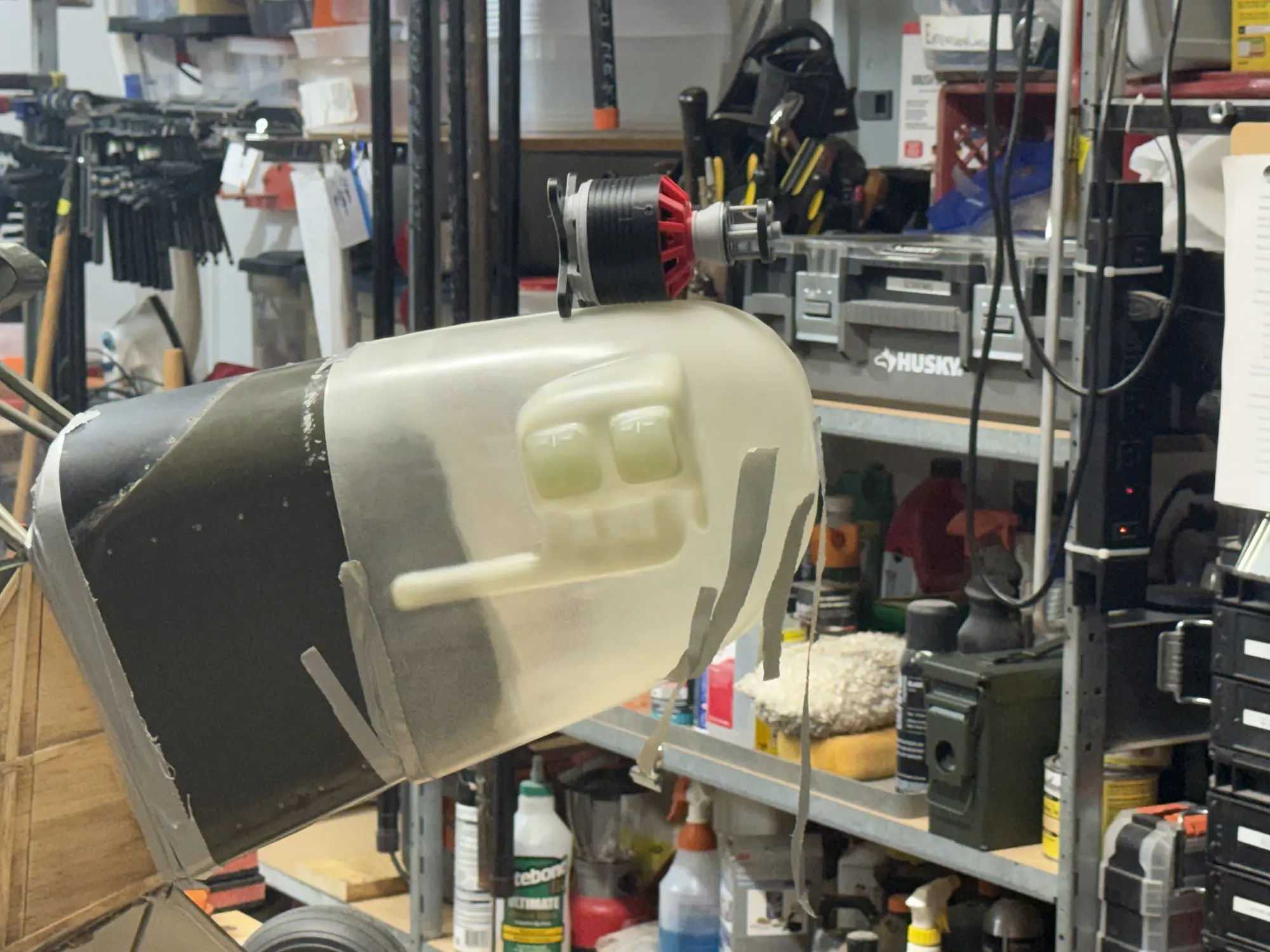
The printed Continental dummy-engine prototype provides a way to judge scale appearance against the nose and cowl. It is a cosmetic fit study, mechanically separate from the electric motor. Motor-box length must put the propeller driver and spinner in the right place while preserving cooling, wire clearance and access to the mounting hardware.

The next useful measurements are firewall-to-prop-driver distance, cowl depth, cross-mount pattern, shaft line, any thrust offset and the motor removal path. The restored firewall and its load path need inspection before a permanent box is bonded.

See the dummy-engine fit study →
Printed Continental dummy-engine prototype fitted to the L-4 cowl for evaluation
Prototype cowl study. This does not show a finished motor mount.

Where it stands

A working direction, with real hold points.

The favored motor, 12S architecture and manufacturer-guided plywood-box concept give the restoration a concrete path. The propeller, batteries, physical ESC assignment, final box geometry, cooling and center of gravity are still subject to aircraft-specific checks.

  • Measure the completed nose and establish mount depth and thrust line.
  • Confirm battery fit, extraction, retention, mass and CG before committing trays.
  • Verify real current, RPM, vibration, temperature, cooling and ground clearance in the installed aircraft.

No motor box is claimed as built, no propulsion system is claimed as installed, and no eCalc number is presented as flight data.