JHJon's Hangar
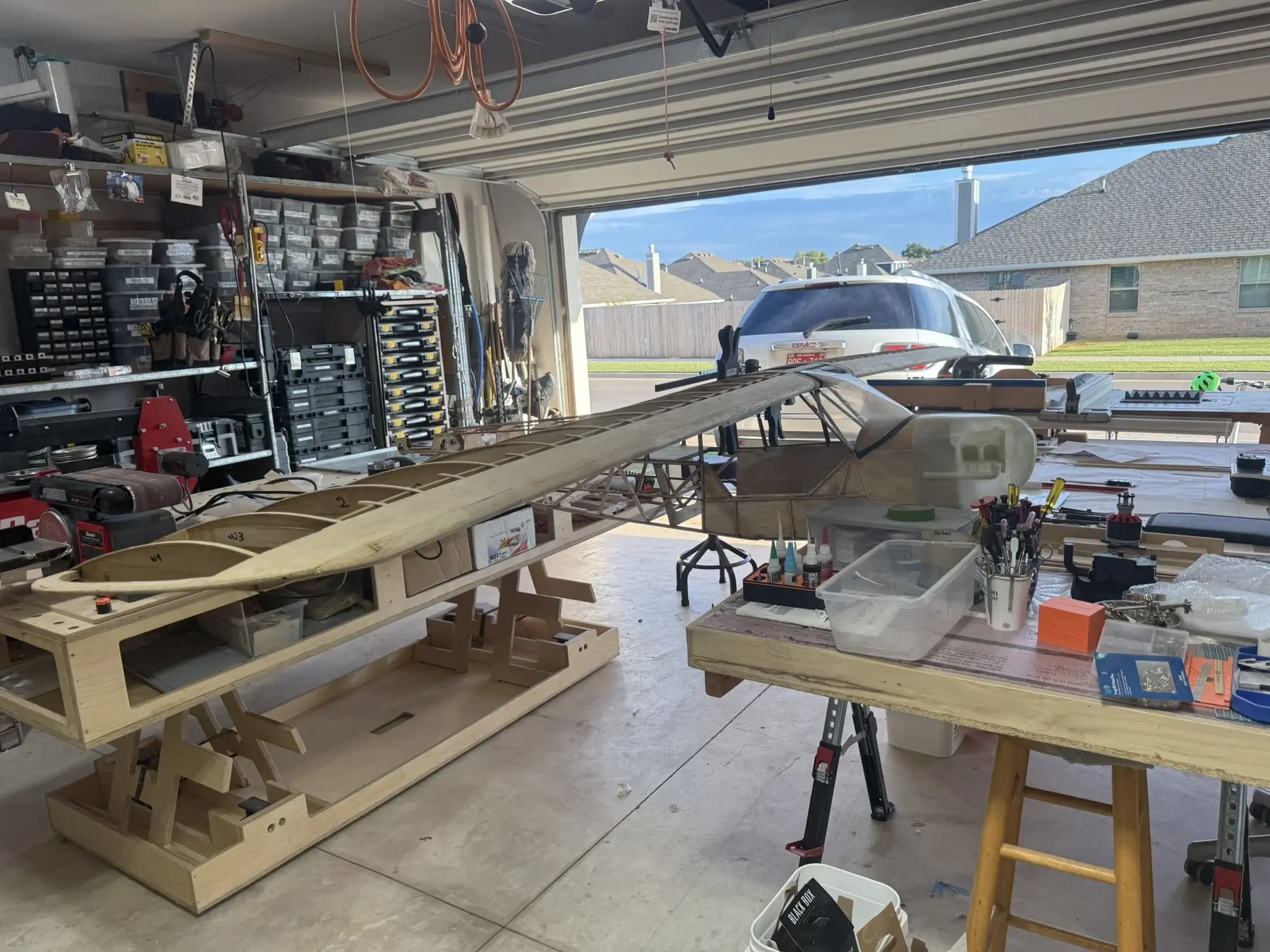
Balsa USA one-third-scale L-4 Grasshopper airframe assembled in Jon's workshop

L-4 Engineering Rabbit Hole

Choosing the L-4 Electric Power System

By Testing, Not Guessing

The complete power system is being compared around the airplane's needs: scale-like performance, reliability, thermal margin, flight time, weight and cost.

Methodology

Start with the airplane, not the motor catalog.

There is a very easy way to choose an electric motor for a giant-scale airplane: open a motor catalog, find something that looks large enough, and work backward until the numbers seem acceptable.

That is not what we did.

For the 1/3-scale Balsa USA L-4 Grasshopper, the power-system decision started with the airplane itself:

AirframePropellerRequired PowerVoltageMotorModeled CurrentESCBattery

That sequence turned into one of those classic Jon's Hangar Rabbit Holes. The deeper we went, the more useful the question became.

The original question was simple:

Which electric motor should power a roughly 35-pound 1/3-scale L-4 Grasshopper?

The better question became:

Which complete power system gives the airplane the right combination of scale-like performance, reliability, thermal margin, flight time, weight and cost?

That is what we tested.

The L-4 is not a 3D airplane and it is not intended to be flown like one. The target is a large, believable Grasshopper with enough authority for safe takeoff, climb, go-around and normal maneuvering—without carrying unnecessary motor, battery or propeller.

Airframe
Balsa USA 1/3-scale J-3 / L-4
Target flying weight
Approximately 35 lb
Wing area
Approximately 2,820 sq in
Power system
12S LiPo
Target flight time
Roughly 8–10 minutes
ESC
Castle Phoenix Edge HV 160
Propeller
APC Electric 24×10, 2-blade
Field elevation
Approximately 1,200 ft
Modeled conditions
70°F · 29.92 inHg

Before motor selection, we had already worked through the propeller question. Using the Balsa USA plan geometry and the established main-wheel diameter, the 24-inch propeller showed approximately 4.74 inches of geometric ground clearance in the tail-up, approximately level takeoff attitude.

Earlier tests with 24×8, 24×10 and 24×12 props pointed to the 24×10 as the best overall compromise for this airframe. The 24×8 did not provide enough pitch-speed margin; the 24×12 added power and heat that the L-4 did not need.

So the propeller became a constant. That matters, because now the motors could be compared on equal terms.

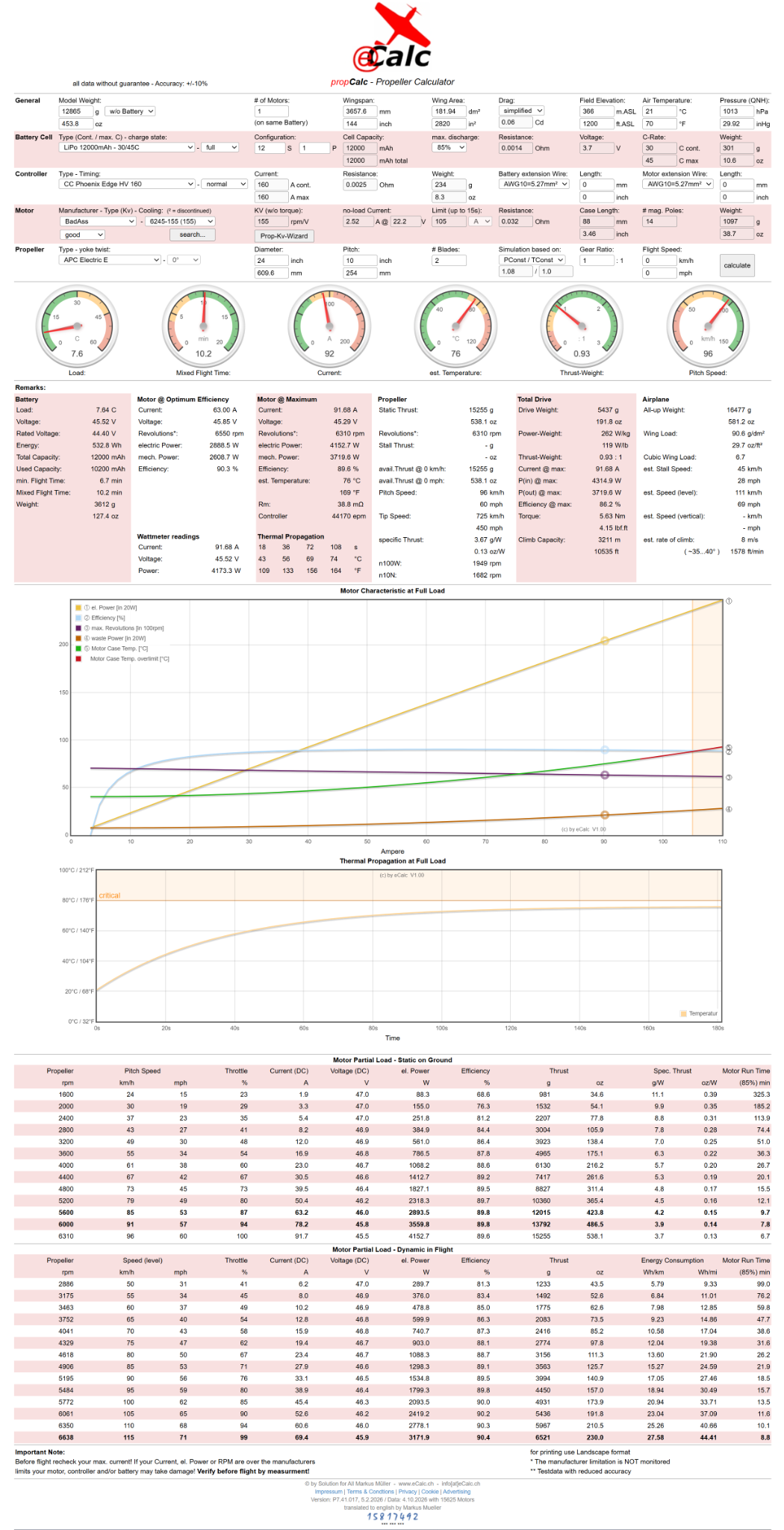
Preview of the eCalc result sheet for the BadAss 6245-155Kv motor on 12S with a 24 by 10 propeller and 12,000 milliamp-hour batteryView full result sheet ↗
BadAss 6245-155Kv12S · 24×10 · 12,000 mAh91.68 A · 3,719.6 W mechanical · 76°C · 0.93:1 thrust-to-weight
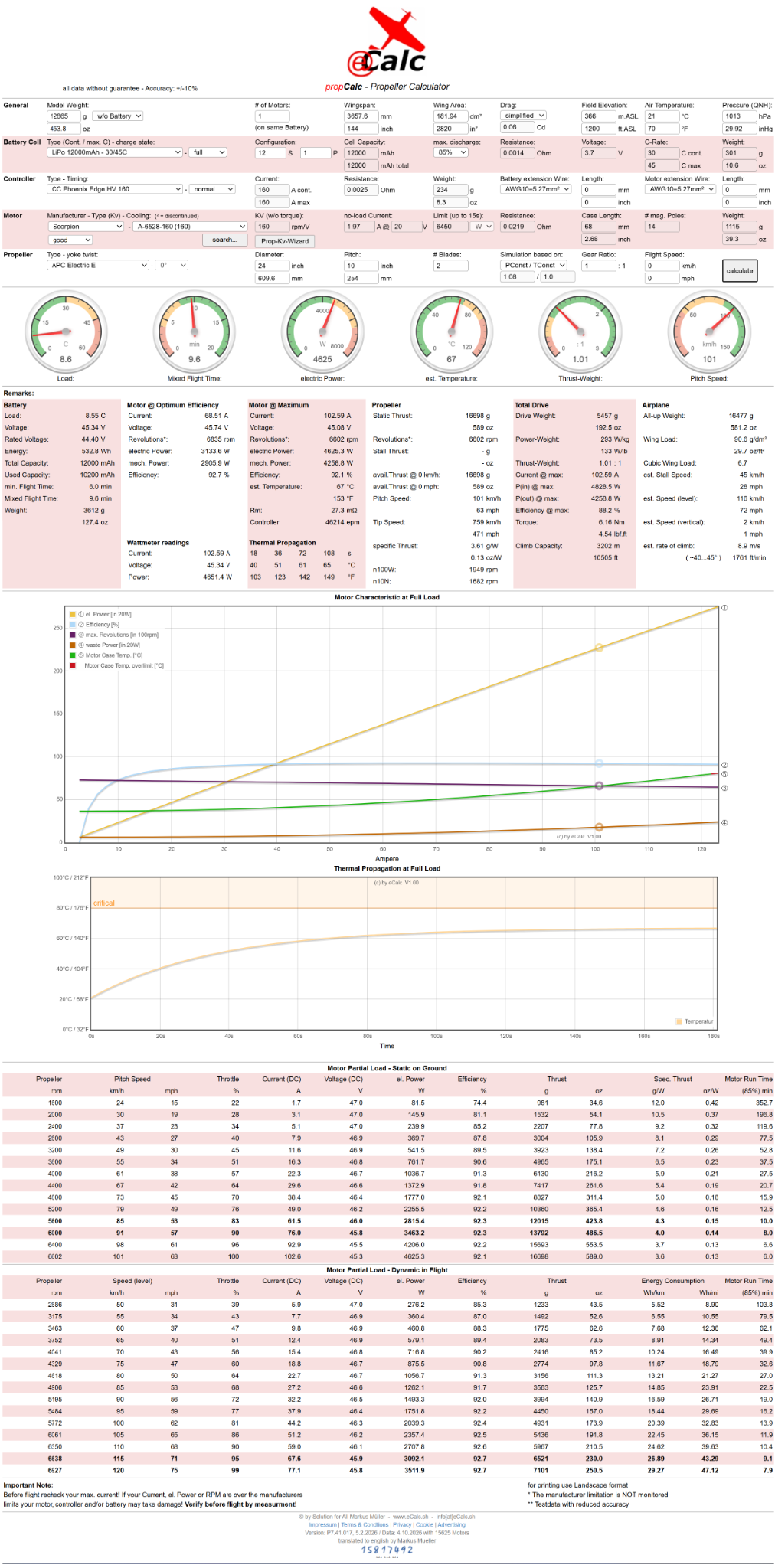
Preview of the eCalc result sheet for the Scorpion A-6528-160 motor on 12S with a 24 by 10 propeller and 12,000 milliamp-hour batteryView full result sheet ↗
Scorpion A-6528-16012S · 24×10 · 12,000 mAh102.59 A · 4,258.8 W mechanical · 67°C · 1.01:1 thrust-to-weight

Why eCalc became essential

The battery could not remain weightless.

This is where eCalc.ch became more than a quick motor calculator.

We initially ran conventional fixed-weight comparisons. Those were useful for understanding propeller and motor behavior, but they exposed an important limitation in our test method: if we changed battery capacity while holding the airplane at exactly 35 lb, we were pretending a larger battery had no weight penalty.

That is not how airplanes work.

The eCalc help documentation showed the better method. For Model Weight, eCalc allows the user to enter all-up weight including the drive, weight less battery, where eCalc adds the selected battery weight, or basic weight without the drive, where eCalc adds the chosen propulsion components.

For the battery comparison, we selected “less Battery.”

Our working model weight became:

453.8 oz / 28.36 lb without the propulsion battery

From there, every battery choice changed the actual calculated flying weight. That one change made the battery comparison dramatically more meaningful.

BatteryCalculated all-up weight
8,000 mAh33.68 lb
10,000 mAh35.00 lb
12,000 mAh36.33 lb
14,000 mAh37.65 lb
16,000 mAh38.97 lb

Model basis: both motors use the same 12S configuration, 30/45C LiPo battery family, Castle Phoenix Edge HV 160, APC Electric 24×10 propeller and 453.8 oz model weight less battery. The battery was no longer “free flight time.” Every extra milliamp-hour had to carry itself.

Results

Two finalists, one common test.

The BadAss 6245-155Kv became the value benchmark. The Scorpion A-6528-160 represented the premium technical option. The question was not which name we liked better. It was what each motor did in the same airplane with the same ESC, propeller and battery options.

Value benchmark

BadAss 6245-155Kv

At 12,000 mAh, eCalc predicts 3,719.6 W mechanical power, 33.63 lb static thrust, a 0.93:1 thrust-to-weight ratio and 10.2 minutes of mixed flight.

The tradeoff is temperature: the modeled motor temperature reaches 76°C, leaving less margin inside a Cub cowl.

Premium technical option

Scorpion A-6528-160

At 12,000 mAh, eCalc predicts 4,258.8 W mechanical power, 36.81 lb static thrust, a 1.01:1 thrust-to-weight ratio and 9.6 minutes of mixed flight.

The modeled temperature is 67°C. That cooler result is the most important Scorpion advantage.

BadAss variable-weight results

BatteryCurrentMech. PowerTemp.Static ThrustT/WMixed Flight
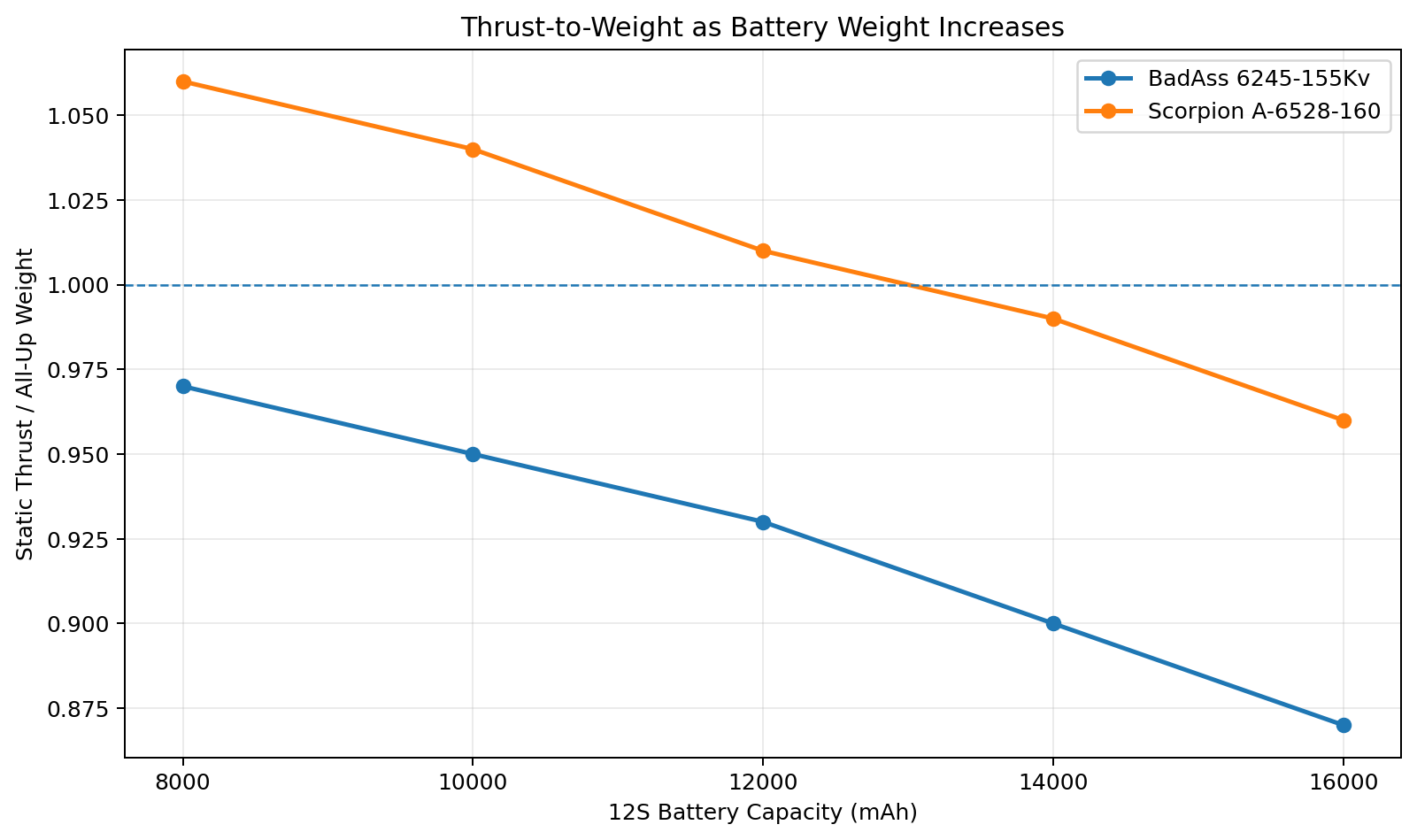
8,00089.12 A3,560.9 W74°C32.67 lb0.977.2 min
10,00090.56 A3,650.0 W75°C33.21 lb0.958.7 min
12,00091.68 A3,719.6 W76°C33.63 lb0.9310.2 min
14,00092.45 A3,767.4 W77°C33.92 lb0.9011.6 min
16,00092.83 A3,791.8 W77°C34.07 lb0.8713.0 min

Scorpion variable-weight results

BatteryCurrentMech. PowerTemp.Static ThrustT/WMixed Flight
8,00099.35 A4,054.7 W65°C35.63 lb1.066.8 min
10,000101.17 A4,169.0 W66°C36.29 lb1.048.3 min
12,000102.59 A4,258.8 W67°C36.81 lb1.019.6 min
14,000103.57 A4,320.8 W68°C37.17 lb0.9910.9 min
16,000104.07 A4,352.4 W68°C37.35 lb0.9612.2 min
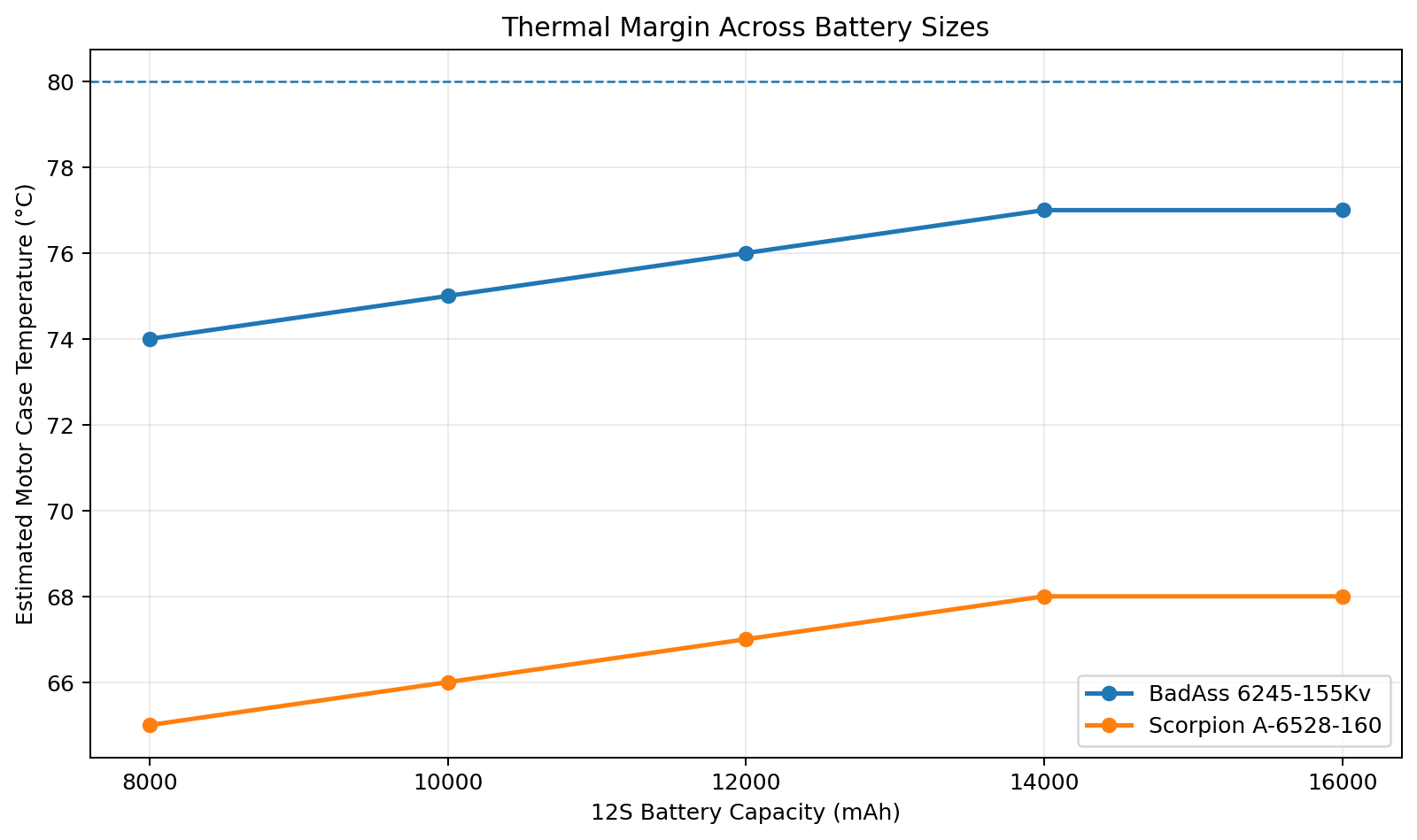
Line chart comparing modeled motor case temperature for the BadAss and Scorpion motors across 8,000 to 16,000 mAh batteries
Thermal margin across battery sizesThe Scorpion remains about 9–10°C cooler in the eCalc model. The dashed line marks the 80°C caution point used for this comparison.

The battery Rabbit Hole

Endurance is not free.

Larger battery packs kept adding modeled flight time, but the weight line told the rest of the story. A 16,000 mAh pack pushes the calculated airplane to almost 39 lb. It also reduces thrust-to-weight ratio and adds mass to every takeoff, landing and maneuver.

For this airplane, the most attractive range is clearly:

10,000–12,000 mAh

The 10,000 mAh pack keeps the airplane at the original 35-pound working target. The 12,000 mAh pack raises the model to about 36.3 lb, but reaches almost exactly the desired 10-minute mission.

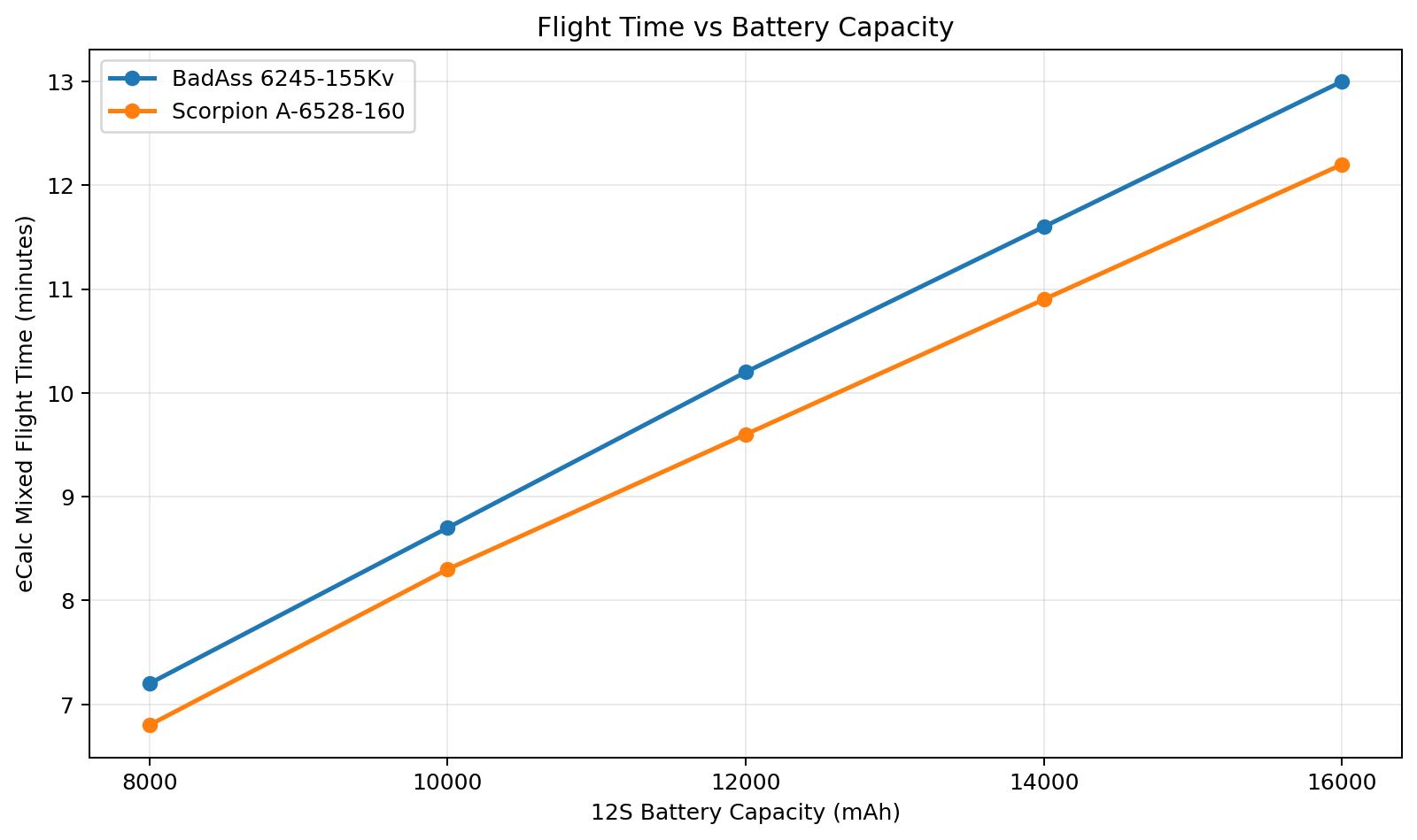
Line chart comparing modeled mixed flight time for the BadAss and Scorpion motors across 8,000 to 16,000 mAh batteries
Modeled mixed flight timeCapacity adds endurance, but each larger pack also adds battery mass to the airplane.
Line chart comparing modeled thrust-to-weight ratio for the BadAss and Scorpion motors as battery capacity and airplane weight increase
Thrust-to-weight as battery weight increasesThe dashed line marks a 1:1 ratio. Larger packs increase endurance while steadily reducing thrust-to-weight.

Unless center of gravity shows that the airplane benefits from additional battery mass, the 14,000 and 16,000 mAh options appear to solve a problem the L-4 does not have.

What We Learned

The simulation narrowed the useful choices.

Propeller24×10A balanced compromise for thrust, pitch speed, current and heat.
Battery range10–12 AhBest match to the 35-pound target and roughly 8–10 minute mission.
Voltage12SKeeps current in a practical region for this power level.
BadAss at 12 Ah0.93 T/WEnough modeled thrust for useful L-4 performance.
Scorpion at 12 Ah67°CAbout 9°C cooler than the BadAss in the same modeled case.
ESCHV 160The existing Castle candidate retains useful current headroom.

The BadAss uses roughly 10–11 fewer amps than the Scorpion at comparable battery sizes and gives slightly longer modeled mixed flight time. The Scorpion consistently produces more shaft power and static thrust while running substantially cooler in the model.

The extra Scorpion thrust is useful. The cooler modeled operation is more important.

Current Conclusion

The system envelope is preferred. The final motor is not selected.

The preferred working system is now:

12S · APC Electric 24×10 · Castle Phoenix Edge HV 160 · 10,000–12,000 mAh battery

Value choice

BadAss 6245-155Kv

It already provides enough modeled thrust and power for the airplane. If the price difference remains substantial, it is difficult to dismiss.

Premium / thermal-margin choice

Scorpion A-6528-160

It provides more modeled power and thrust while running substantially cooler. If installed cost becomes reasonably close, it is the stronger technical choice.

The battery decision remains deliberately open until the airplane can tell us what it needs for center of gravity. That is a much better place to be than choosing the largest battery simply because it fits.

Evidence boundary: these are eCalc predictions, not measured flight results. Final selection and release still require actual finished-airplane weight, center of gravity, battery mass, full-power current and voltage, motor temperature, propeller RPM and installed-cowl cooling tests.

Later Development

The study continued after this comparison.

This article preserves its 24×10, variable-battery comparison as modeled at the time. A later 24×8 fixed-input study favored the BadAss BA-6245-155Kv for the next engineering stage, then an inquiry to Innov8tive Designs turned to a plywood motor-box concept. Those runs use different propeller and battery inputs; their numbers are not directly interchangeable. Final installed choices remain open.

Follow the motor and mount story →

Why eCalc Was Worth Subscribing To

The value was not one answer. It was a test record.

The free calculation is useful. The subscription became valuable when the task stopped being a one-answer question and became an engineering comparison.

For this project, the important subscriber tools included exporting calculations to CSV for spreadsheet analysis, saving and sharing configured setups, and accessing detailed partial-load static and dynamic-in-flight tables.

The CSV export allowed us to stop comparing screenshots by eye and build a permanent workbook containing the configurations, results, corrections and direct motor-to-motor comparisons.

That turns eCalc from a calculator into part of the project's engineering record. This article documents Jon's independent use of the tool and does not imply sponsorship, endorsement or affiliation.

Download the Data

L-4 eCalc Motor / Battery Comparison Workbook

The complete working record includes the original fixed-weight tests, corrected variable-weight tests, direct BadAss-versus-Scorpion comparisons, raw eCalc exports, battery and all-up weights, current, power, temperature, thrust, thrust-to-weight and flight-time results.

Download the Workbook

What this test does—and does not—prove

eCalc is a modeling tool, not a substitute for final ground testing.

The next stage will eventually require real measurements:

  • actual finished airplane weight,
  • actual center of gravity,
  • real battery pack mass,
  • full-power current and voltage,
  • motor temperature after realistic ground and flight operation,
  • propeller RPM,
  • and cooling effectiveness inside the completed cowl.

Those measurements will either confirm the model or teach us where the model needs adjustment.

That is the point.

The Rabbit Hole is not about finding a calculator that tells us what answer to buy. It is about using the calculator to ask better questions before we spend money, cut wood or put a 35-pound airplane in the air.

Start with the airplane, not the motor catalog.