186 × 70 × 69 mm each
FitsBoth packs could be accommodated with meaningful clearance still available for the ESC.

L-4 Engineering Rabbit Hole
Why Capacity Wasn't the Real Problem
We initially thought the question was whether the L-4 could carry two 12,000 mAh batteries. The mockups showed that was the wrong question. What mattered was not capacity—it was shape.
The wrong first question
This is a fit-and-selection study across the practical 9K–12K range, driven by an approximately ten-minute flight target. The goal is not to declare that the largest battery wins; it is to understand which packs can fit, what their weight adds, and what the finished airplane may need for balance.
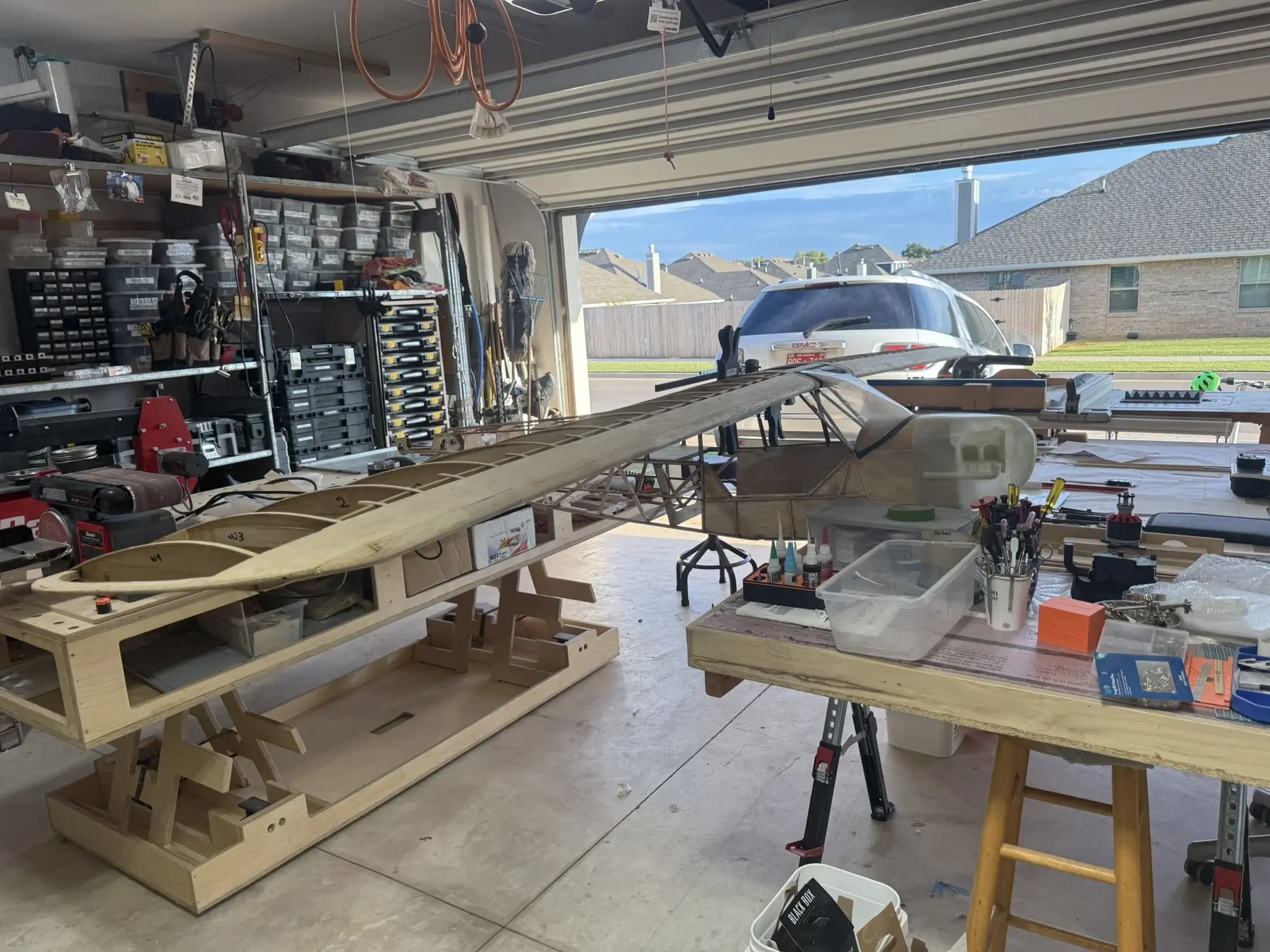
The L-4 is being developed around a 12S electric system made from two 6S packs connected in series. The forward fuselage offers useful volume, but it is not a convenient rectangular box. It narrows toward the firewall, its floor rises toward the nose, and normal battery changes must work through the intended access.
The ESC shares the same forward area. So do its wiring and the planned cooling path. A battery that fits alone can still fail the airplane if a second pack cannot join it, if it cannot pass through the access, or if it crowds the ESC and blocks airflow.
How large a battery can we carry?
That sounded like the decision. The airplane turned it into a better question:
Which pair has the right geometry, electrical capability, cooling relationship and serviceability?
Building batteries before buying batteries
Buying several pairs of expensive 6S batteries just to discover that they would not fit made no sense. Lightweight mock batteries were built to reproduce the outside dimensions and trial-fitted in the actual tapered fuselage.
The mockups did not need to imitate real battery construction. They only needed to preserve each pack's external envelope accurately enough to expose access, interference, wiring and clearance problems.
Both packs could be accommodated with meaningful clearance still available for the ESC.
Even staggered, the pair could not share the bay. Width—not capacity itself—was the governing failure.
The failed mock did not prove that 12,000 mAh was impossible. It proved that one broad 12K geometry was wrong for this airplane.
The turning point
The L-4 has more usable height than tray width. A pack published as 183 × 77 × 58 mm does not have to consume a 77 mm-wide footprint. Rotating it around its long axis makes the working footprint 183 × 58 mm, while the 77 mm dimension becomes vertical.
Too broad for the demonstrated 70 mm tray boundary.
Fits the width boundary when the actual bay provides the vertical space.
This is a physically demonstrated fit boundary—not a zero-clearance tray specification. The final installation still needs tolerance for shrink wrap, leads, connectors, padding, straps, carrier structure and practical removal.
Real batteries changed the answer again
The shortlist was researched model by model rather than by capacity class. The 10K class is the physically demonstrated baseline; the 9K–12K range is being studied because the target is approximately ten minutes of useful flight, not because one capacity has already been chosen.
Published dimensions were rotated where appropriate, checked against the proven footprint and treated conservatively when sources disagreed.
| Representative candidate | Capacity | Published dimensions | Working footprint | Pair weight | 12S energy |
|---|---|---|---|---|---|
| Zeee 6S 9000 100C | 9,000 mAh | 166 × 49 × 63 mm | 166 × 49 mm | 2.27 kg / 5.01 lb | 399.6 Wh |
| HRB 6S 10000 25C | 10,000 mAh | 165 × 64 × 63 mm | 165 × 63 mm | 2.45 kg / 5.41 lb | 444.0 Wh |
| MaxAmps 6S 11000 | 11,000 mAh | 161 × 60 × 60 mm | 161 × 60 mm | 2.54 kg / 5.60 lb | 488.4 Wh |
| HRB 6S 12000 25C | 12,000 mAh | 180 × 70 × 51 mm | 180 × 51 mm | 2.85 kg / 6.28 lb | 532.8 Wh |
Dimensions, weights and ratings above are published specifications used for screening. They remain subject to battery-in-hand verification.
The 10K-class mock pair is the proven starting point: approximately 186 × 70 × 69 mm each, fitting with meaningful ESC clearance. A real 10K candidate remains valuable because it can preserve weight and installation margin while contributing to the roughly ten-minute target.
At approximately 180 × 70 × 51 mm, it can be oriented to use an approximately 180 × 51 mm footprint. It is the strongest 12K candidate identified at this research stage—not a purchased or final selection.
Bar length represents nominal 12S pair energy. The labels preserve the equally important pair-weight tradeoff.
The C-rating Rabbit Hole
At the current 105 A planning ceiling, a 10,000 mAh pack mathematically needs about 10.5C, an 11,000 mAh pack about 9.5C, and a 12,000 mAh pack only 8.75C. A credible 20C–30C large pack already has substantial theoretical headroom.
The useful question is not “Which battery has the largest C-rating?” It is “Which battery can comfortably deliver the current this airplane actually requires while remaining cool, stable, reliable and reasonably light?”
Evidence hierarchy
The independent research did not find controlled exact-model testing for the shortlisted packs. Published C-ratings therefore remain screening information, not independently proven performance. Final acceptance still requires baseline internal-resistance records, conservative ground-load testing, voltage-sag observation and temperature checks on the actual batteries.
Mechanical fit is not electrical approval
A standard 6S LiPo reaches 25.2 V fully charged, or 50.4 V for two packs in series. A 6S LiHV pack can reach 26.1 V, producing 52.2 V as a 12S pair. That exceeds the present 50.4 V design ceiling associated with the Castle Phoenix Edge HV 160.
The ESC is intended to receive the coolest incoming air first. A pack that can be forced into the bay but crowds the controller, wiring or downstream airflow is not a successful installation.
The successful 10K mock pair was especially encouraging because it preserved meaningful ESC clearance.
Current decision point
The 10K-class mock pair physically fits. The broad 12K mock did not. Width was the governing dimensional problem, and rotating real packs makes several 12K candidates viable. The HRB 12K is the strongest dimensional 12K candidate so far, but no final battery has been purchased or selected.
The final choice will also depend on the finished airplane’s center of gravity. If the L-4 needs weight in the nose, a heavier battery may serve a useful balancing purpose; if it does not, the lighter pack that still supports the approximately ten-minute mission may be preferable. Battery weight cannot be judged separately from the airplane’s balance.
Next comes a battery-specific mockup, exact-orientation trial fit, connector and removal checks, measured motor/prop current, and battery-in-hand electrical validation. Only then should the permanent carrier be designed.
The airplane did not ask for a 10K battery or a 12K battery. It asked for a battery with the right geometry, weight, voltage, current capability, cooling relationship and serviceability.
The complete project narrative covering mock-battery development, physical fit testing, dimensional research, C-rating analysis, independent evidence, voltage limitations, cooling and current conclusions.
The working comparison of dimensions, rotated fit, weight, energy, published capability, manufacturer sources, exclusions and independent-performance evidence.
The research PDF is also embedded in the workbook for offline reference; it is offered separately here for readers who do not need the spreadsheet.